
A great profile helps the right people choose you. Most visitors are not experts: they arrive with a need, like “I can’t sleep” or “I want to get fitter after 60”, and decide in a few seconds whether you’re for them.
Profile or class description: what goes where?
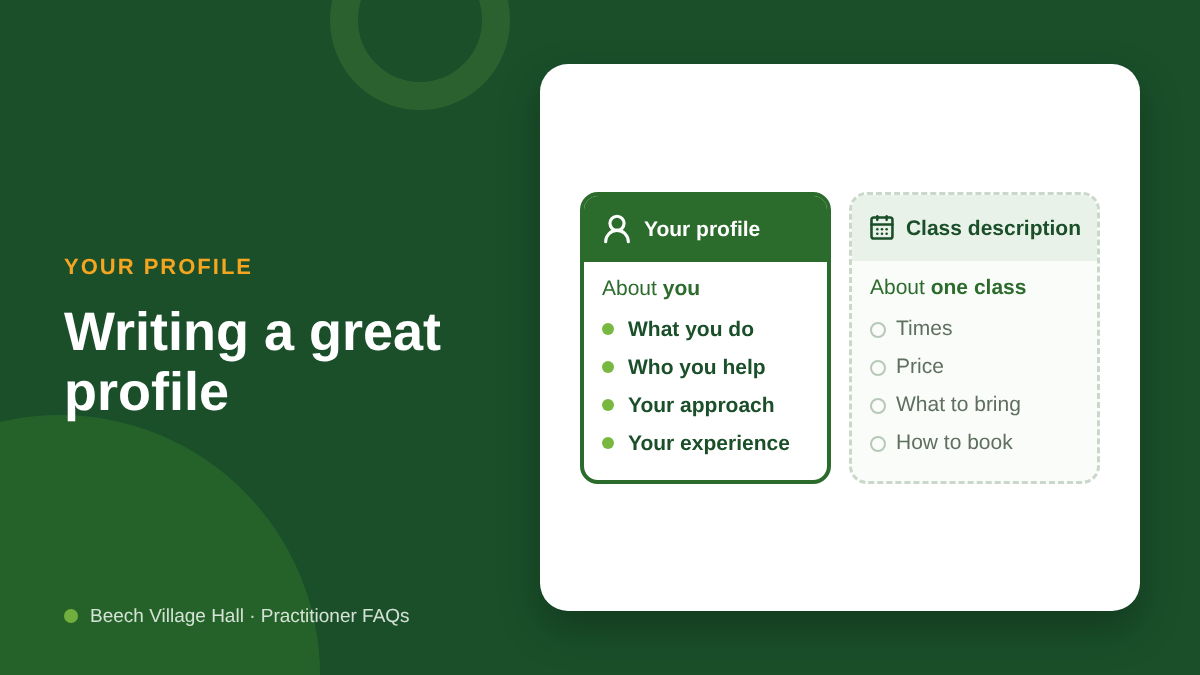
Your profile is about you. Your class description is about one class. Keeping them separate means your profile stays true for months, while class details can change without anyone touching your profile.
| Your practitioner profile | Your class description | |
| What it’s about | You, your approach and everything you offer | One specific class or session |
| Where it lives | Your profile page on our website | Each booking in HallMaster |
| Who updates it | We do, when you send us changes | You do, in HallMaster |
| How often it changes | Rarely | Whenever the class changes |
| What to include | What you do and why, who you help, what working with you is like, your experience, all the classes or services you offer, how to contact you | Level and who it suits, what happens in the session, real start and end times, what to bring, price, how to book |
| Leave out | Days, times, prices and term dates, as they go out of date | Your life story and qualifications, as they belong on your profile |
Why it’s worth getting right
- Visitors scan, they don’t read. A clear first sentence tells them straight away whether to read on.
- Plain words get found. People search Google and AI assistants in everyday language, like “gentle yoga for beginners near Alton”. If your profile uses the same words, it’s more likely to show up.
- It builds trust before the first visit. Knowing who you are and what working with you is like takes away the nerves that stop people booking.
How to write your profile: five building blocks, about 100–150 words
- What you do, in one sentence. Lead with the benefit, not your title.
- Who you help. Beginners, over-60s, new parents, people living with pain or stress. Match this to the Goals / Conditions you choose.
- What working with you is like. Your style and approach in general terms, such as gentle, sociable or one-to-one and unhurried.
- Your experience, briefly. One line on qualifications and years of practice. Spell out acronyms.
- What you offer and how to get in touch. Name your classes or services without times or prices, plus your website link.
Example: a yoga teacher
Profile before: “Jane is a fully certified RYT-500 Hatha and Vinyasa teacher with 15 years’ experience, integrating pranayama, yin and restorative principles into a holistic practice. Classes Tuesdays 9.30am, £8.”
Profile after: “I teach gentle, friendly yoga to help you move more easily and feel calmer. My classes suit complete beginners and anyone who feels a bit stiff, including older adults. Everything can be adapted, so you work at your own pace with no pressure. I’ve taught yoga for 15 years and hold an advanced (500-hour) teaching qualification. At Beech I run a weekly Gentle Yoga class and occasional relaxation workshops. Find out more at www.janesmithyoga.co.uk.”
Class description, written in HallMaster for each booking: “Gentle Yoga, 9.30–10.30am. Suitable for complete beginners and all ages. We start with simple breathing, move into slow stretches you can adapt, and finish with a short relaxation. Wear comfortable clothes; mats provided. £8 drop-in. Book at www.janesmithyoga.co.uk.”
Example: a reflexologist
Profile before: “Reflexology treatments available. Fully insured. Contact for prices.”
Profile after: “Relaxing reflexology to help you unwind and take time for yourself. Many of my clients come to me when they’re feeling stressed or sleeping badly. Sessions are calm and unhurried: we start with a short chat, then you relax in a reclining chair while I work on your feet. I’m a qualified, insured member of a professional reflexology association with 8 years’ experience. I offer one-to-one appointments at Beech Village Hall. Book at www.examplereflexology.co.uk.”
Quick tips
- Write as if you’re talking to one person: use “you” and “I” or “we”.
- Keep sentences short and avoid jargon. If you must use a technical term, explain it.
- Describe how people may feel, not medical results. Say “may help you relax” rather than “cures anxiety”: it’s more honest, and advertising rules restrict health claims.
- If it would change next term, it belongs in the class description, not your profile.
- Read it aloud. If it sounds like you, it’s working.
Questions?
Search our FAQ’s
Search
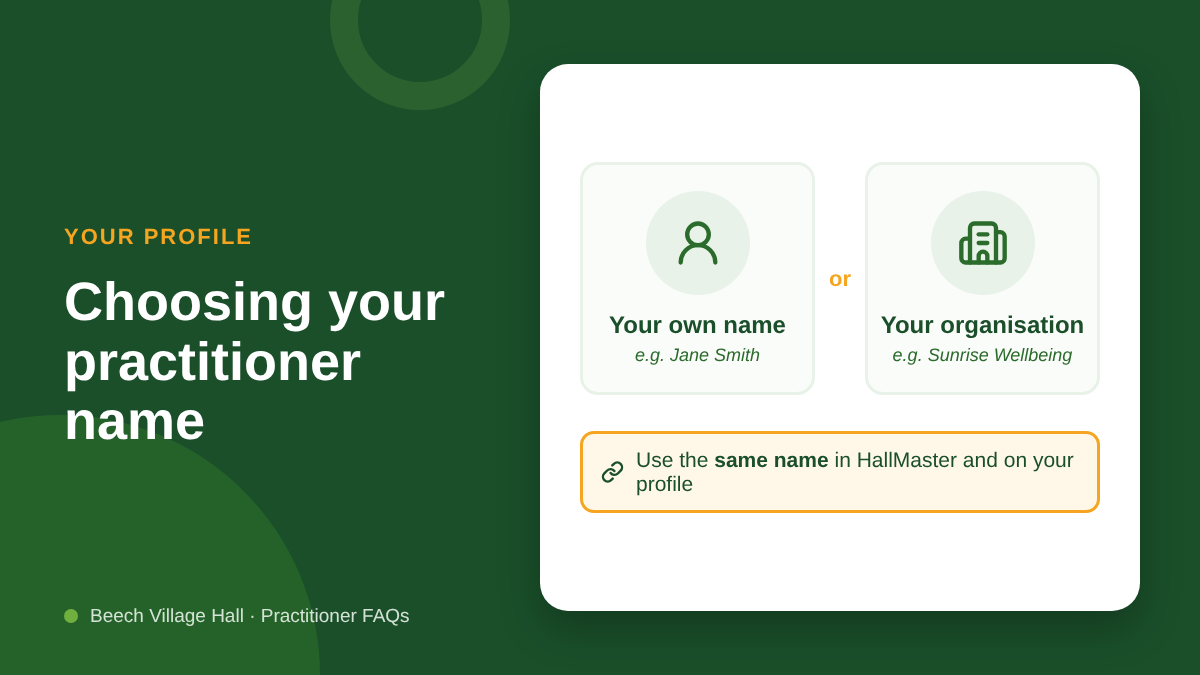
Help on my Practitioner name
We use your customer name in HallMaster to link your…

How do I join the Practitioner community?
Ready to join? Click below to complete and submit our…
How do I set up my Practitioner profile?
We will set up your Practitioner profile on our website,…
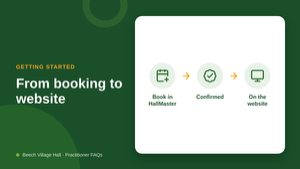
How does my class get onto the Beech Village Hall website?
Once your practitioner profile is set up, it’s automatic. You…
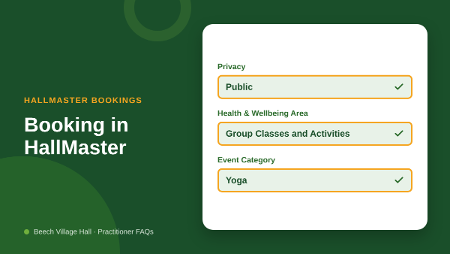
How to create a class in the HallMaster system?
As part of the Health and Wellbeing onboarding process we…
How to write a great Practitioner profile?
A great profile helps the right people choose you. Most…
What makes a good class description?
Keep it short: most people read it on a phone….
Contact
Complete our contact form and select the activity ‘Help with booking’