
Keep it short: most people read it on a phone. A strong class description answers six questions. Work through them in order and your description will write itself:
| Question | What to write |
| 1. Who is this for? | Describe the client’s situation, not the therapy. Write for the person who has never heard of your approach. |
| 2. What level is it? | Be explicit: beginner, all levels, intermediate, advanced. Do not assume people know — a client who is unsure whether they are welcome will not book. |
| 3. What will they do? | Briefly describe the session itself. Keep it concrete and accessible — avoid jargon. |
| 4. How will they feel afterwards? | The outcome. This is what converts browsers into bookers. Be specific — ‘calmer and more grounded’ beats ‘better’. |
| 5. When does the class run? | State the actual class start and finish time clearly — for example ‘9.30am to 10.30am’. Important: the time shown on our live calendar is your booking slot, which includes your setup and tidy-up time. This will not match your class time. Always state the actual class times in your description so clients know exactly when to arrive. |
| 6. How do they book? | Include your direct booking link and/or contact details. Do not make a client search for this — one click from the description to your booking page is the goal. |
Your class description will link on our website to your Practitioner profile. Keep the class description short and use the Practitioner profile for more details.
Text formatting
Keep the formatting simple.
- Use spaces to separate text.
- The import of recurring bookings only includes unformatted text so paragraph and list formatting is ignored
Categories
You can use categories in your HallMaster booking to make it easier for clients to find your class. You can select ONE from each of:
- Health and Wellbeing category
- Health and Wellbeing area
Questions?
Search our FAQ’s
Search

How do I join the Practitioner community?
Ready to join? Click below to complete and submit our…
How do I set up my Practitioner profile?
We will set up your Practitioner profile on our website,…
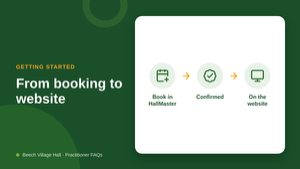
How does my class get onto the Beech Village Hall website?
Once your practitioner profile is set up, it’s automatic. You…
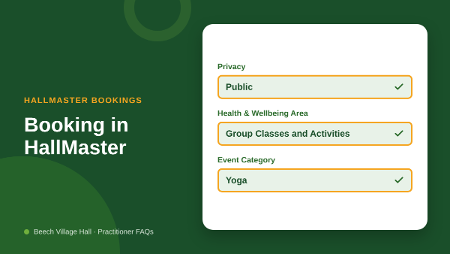
How to create a class in the HallMaster system?
If you have not already registered with our HallMaster bookign…
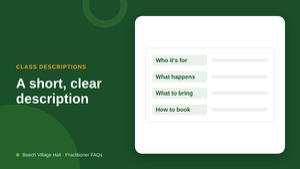
What makes a good class description?
Keep it short: most people read it on a phone….
Contact us?
Complete our contact form and specify ‘Help with space hire’ as the area: