
The nearest registry office is in Alton:
Hall hire
Advertising at the Hall
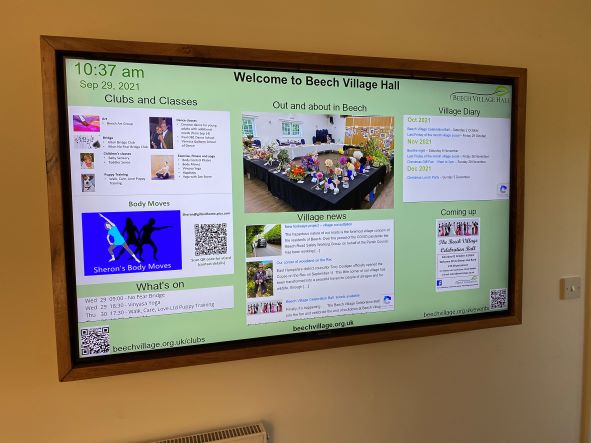
The digital noticeboard in the main lobby at Beech Village Hall is a focal point for users of the Hall who are seeking information about village events and activities. We estimate that the screen is visible to more than 2,000 people every month. Those who run regular classes at the Hall receive free promotion on this screen. In addition, we are offering a limited number of advertisement opportunities for local traders at a cost of £50 per quarter or £150 per year. For further information, please download Advertising at Beech Village Hall or contact us:
In addition, Beech News is a hard-copy magazine which is hand-delivered to all households in Beech every quarter. If you are interested in advertising in Beech News, please contact Camilla Gibson at beechnews@beechvillage.org.uk
How to use the Audio Visual system in the main hall?
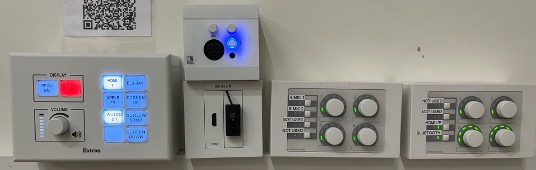
The main hall has a range of audio visual equipment to support:
- Music and dance played through a 2 channel disco sound system with disco lights and a choice of inputs:
- BlueTooth
- 3.5mm jack plug
- HDMI
- Presentation from a computer using an HDMI input
- Public address using a microphone
- Film and theatre presentations to our 4.5M wide screen using a 4K UHD 7,500 Lumens laser projector from:
- UHD Blu-ray disc
- Digital streaming services for example BBC iPlayer
- Live events broadcast using digital streaming services
How to use the Audi Visual (AV) system
Please review our BVH Audio Visual system user guide
Please note:
- Whilst the hall has a Premises License that covers these activities the hirer is responsible for ensuring they have the appropriate copyright licenses for the materials that they use.
- As we are located in a quiet and peaceful village with close neighbours we specify a maximum noise level in our terms and conditions. For more information please see this FAQ article:
- Usage of some our Blu-ray player or microphones requires access to our media cupboard which must be arranged in advance.
How do we hire the skittle alley?
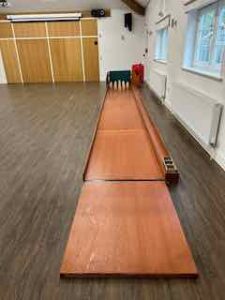
The hall has a simple ‘self assembled’ wooden skittle alley. The skittle alley is available for hire. Please note:
- To hire the skittle alley please select ‘Skittle alley for use in main hall’ from the line item group ‘Skittle alley’ in the online booking form.
- The skittle alley is comprised of several wooden sections each of approximately 1 meter x 1.5 meter
- The skittle alley occupies space within the main hall
- The hirer is responsible for:
- Moving the skittle alley ‘sections’, skittles and ball from the storage shed into the main hall
- The sections are heavy so require 2 people to move
- Locating the skittle alley so that it does not obstruct the fire exit(s)
- Assembling the skittle alley
- Returning the elements of the skittle alley to the storage shed
- Moving the skittle alley ‘sections’, skittles and ball from the storage shed into the main hall
- The hall team can optionally set the skittle alley up subject to their availability and an extra charge
- When using the skittle alley:
- Avoid walking up and down the skittle alley.
- Do not stand on the skittle alley or in the buffer zone during play.
- The balls and skittles are heavy, keep an eye on children during play.
- The hirer is responsible for the safe keeping of the skittle alley, skittles and balls.
- Any damage or lost skittles or balls MUST be paid for.
Skittles – Rules of the Game
As the game of skittles varies from region to region these rules are provided as a guideline only.
General Rules
1.1 An impartial referee / scorer should be nominated and a set of rules agreed.
1.2 The game is split into an agreed number of LEGS e.g. 5.
1.3 Each player has one TURN per LEG.
1.4 During each turn the player has 3 THROWS or BALLS to knock down as many skittle pins as possible.
1.5 The players feet must remain behind the throwing line before releasing the ball.
1.6 Skittle balls MUST be bowled under arm and should NOT bounce.
1.7 After each throw any pins felled are removed from the playing area.
1.8 Skittle pins knocked down after ball ricochets off alley side-walls or back-wall do not count. These should be replaced by the referee.
1.9 If after the first or second throw ALL the pins are knocked down then they are ALL replaced for the next throw.
Knocking down all the pins on the first throw is commonly referred to as a “STRIKE” or “FLOPPER”.
Knocking down all the pins on the second throw is commonly referred to as a “SPARE”.
Scoring
.1 A players score during each LEG is equivalent to the number of pins knocked over.
2.2 Each players score is noted.
2.3 After all LEGS have been completed the OVERALL total score is calculated. This is equal to the sum of all LEG SCORES and represents the total number of pins each player has knocked over during the course of the game.
- The player with the highest score at the end of the game is declared the winner.
How to hire and set up the Marquee?
We have a large Marquee measuring 6m x 12m and this can be placed on our village green outside the hall. The Marquee has side panels but does not have a floor.
The Marquee is available for hire where the hirer commits to set up and take down the Marquee.
- Setting up and taking down the Marquee requires a team of 10 people for 2-3 hours
- The video below steps through the process for a similar marquee.
Marquee set up Safety Basics
A quick guide for volunteers helping put up or take down our 6m x 12m marquee and 3m x 6m stage.
1. Lifting and Carrying
- Never lift alone. Poles, stage decks, and folded marquee sections are heavy and awkward — always use a two- or four-person lift for anything bulky.
- Plan before you lift. Agree who’s carrying, where it’s going, and clear the path first.
- Use good technique: feet shoulder-width apart, bend your knees (not your back), keep the load close to your body, and avoid twisting — turn your feet instead.
- Lift in stages for heavy or high items (e.g. stage sections onto trestles) — rest the load partway if needed rather than forcing it in one go.
- Know your limits. If it feels too heavy or unbalanced, stop and get more hands or a trolley/sack truck.
- Free official training: HSE – Good Manual Handling Technique
2. Gloves
- Wear gloves whenever handling poles, stakes, guy ropes, or stage frames — they protect against splinters, pinch points, and rope burn.
- Use grip-palm work gloves for general rigging; consider cut-resistant gloves if handling metal edges or cutting cord.
- Remove gloves (or use snug-fitting ones) around power tools such as drills, to avoid snagging.
3. Trip Hazards
- Stakes and pegs: flag with hi-vis tape or cones until guy ropes are tensioned and the layout is finished.
- Guy ropes and cables: keep walkways clear; route power cables away from foot traffic or cover them.
- Ground clutter: clear packaging, tools, and offcuts as you go — don’t wait until the end.
- Uneven ground: watch for holes, tent pegs, and cabling especially in low light — consider temporary lighting for early morning or evening builds.
4. General Reminders
- Wear sturdy, closed-toe boots — no sandals or trainers.
- Take regular breaks, especially in hot weather or during long build days.
- Report any near-misses or injuries.
Can we use candles?
As per our ‘Terms and Conditions’ :
No naked lights, including candles, are permitted without prior consent of the Bookings
Manager.
We recommend the use of flameless LED candles as we discourage the use of candles due to:
- The increased risk of fire from naked flames
- The probability that the smoke from the flames may trigger our smoke detectors and fire alarm which in turn will potentially disrupt the event
Our consent to the use of candles would be based on your plan for the appropriate management of the risks.
How to reduce the risk of candle flames starting fires?
- Always put candles on a heat resistant surface. Be especially careful with night lights and tea lights, which get hot enough to melt plastic.
- Put them in a proper holder. Candles need to be held firmly upright by the holder so they won’t fall over. The holder needs to be stable too, so it won’t fall over either
- The holder edge should be higher than the height of the candle flame
- Position them away from curtains. Don’t put candles near curtains or other fabrics – or furniture. And keep them out of draughts
- Keep clothes and hair away. If there’s any chance you could lean across a candle and forget it’s there, put it somewhere else. You don’t want to set fire to your clothes or your hair
- Keep children and pets away. Candles should be out of reach of children and pets
- Keep candles apart. Leave at least four inches (10cm) between two burning candles
- Take care with votive or scented candles. These kinds of candles turn to liquid to release their fragrance, so put them in a glass or metal holder
- Don’t move them when they’re burning. Extinguish candles before moving them. Also, don’t let anything fall into the hot wax like match sticks
- Don’t leave them burning. Extinguish candles before you leave a room. Never go to sleep with a candle still burning. And never leave a burning candle or oil burner in a child’s bedroom
- Use a snuffer or a spoon to put them out. It’s safer than blowing them, which can send sparks and hot wax flying
- Double check they’re out. Candles that have been put out can go on smouldering and start a fire. Make sure they’re completely out.
How to reduce the risk of candles setting off fire alarms
- Keep candles away from fire alarms and smoke detectors. The smoke from a candle can easily travel to a smoke detector and set it off. Place candles at least 3 feet away from smoke detectors.
- Keep candles in a well-ventilated area. A well-ventilated area will help to disperse the smoke from a candle, making it less likely to set off a smoke alarm.
- Don’t leave candles unattended. Always keep an eye on candles when they are burning. If you need to leave the room, blow out the candles.
- Trim wicks to millimetres or 1/4 of an inch. Long wicks can produce more smoke, which can increase the risk of setting off a smoke alarm.
- Clean your smoke detectors regularly. A dirty smoke detector may not be able to detect smoke properly, which could increase the risk of a fire.
- Plant-based wax candles: Finally, using candles that are designed to burn cleanly and produce less smoke, such as soy wax or rapeseed wax candles, can also reduce the risk of triggering a smoke alarm.